Part 2: From Vulnerability Management to CTEM – Building Unified Ownership and Continuous Discipline
In Part 1, we explored why organizations continue to struggle with fragmented risk management, even after deploying numerous tools. The core challenge wasn't the lack of visibility or talent — it was the disjointed approach that prevents security teams from seeing exposure holistically.
To move forward, we now shift the conversation from awareness to action — how to mature into a unified, continuous, and contextual threat exposure management program (CTEM).
Most organizations are still caught in what I call the "scan-and-patch loop." This reactive cycle might check compliance boxes but fails to reduce real risk. Breaking out of it requires more than new technology; it demands a strategic mindset shift across people, process, and ownership.
Four Core Shifts for a CTEM Mindset
1. From Compliance to Risk
Traditional defense is centred on patching every "high severity" vulnerability. But a CVSS score doesn't define business risk. The real question is: Is this exploitable in our environment today? CTEM focuses on relevance and context, ensuring effort targets what truly matters.
2. From Visibility Gaps to Full Exposure Awareness
Security visibility can no longer end with servers and CMDBs. Cloud workloads, SaaS, shadow IT, and forgotten digital assets all expand the attack surface. If it's online, it's an entry point. CTEM demands discovery of the complete exposure surface — not just the assets we know.
3. From Assumptions to Validation
Dashboards that show "active" controls don't prove real defense. Validation, through continuous attack simulation and testing, is what confirms resilience. If you haven't tested the lock, you don't know it's secure.
4. From Periodic Audits to Continuous Cadence
Risk is dynamic. Quarterly audits or monthly scans belong to the past. CTEM operationalizes a live, iterative feedback loop, aligning defense speed with threat evolution.
Establishing the Architecture of Ownership
Even the most refined CTEM strategy fails without clear accountability. Security cannot remain a siloed task. To transform, organizations must define who owns each layer of the program:
| Persona |
Role in CTEM |
Primary Objective |
| CISO / Program Sponsor |
The Strategist |
Negotiate "Remediation SLAs" with business units and secure a budget for the 90-day pilot. |
| Security Architect |
The Navigator |
Map how assets, identities, and vulnerabilities chain together to form "Exposure Paths." |
| Vulnerability Lead |
The Prioritizer |
Filter the 10,000+ alerts into the Top 20 actionable items based on validation data. |
| IT/Cloud Operations |
The Remediation Owner |
Execute the fixes. In CTEM, they receive fewer tickets, but they are the most critical ones. |
| Business Unit Owner |
The Risk Owner |
Provides context on what data is truly "critical" and signs off on maintenance windows for remediation. |
When these roles align under a shared CTEM vision, security stops being reactive firefighting and becomes a coordinated, outcome-driven program.
The CTEM Evolution Journey
Transitioning from legacy vulnerability management to CTEM isn't a tool change — it's a programmatic evolution. Below is how that shift typically unfolds:
| Phase |
Legacy Vulnerability Management |
The CTEM Evolution |
| Strategy |
Compliance-Driven: Patch everything with a CVSS score > 7.0. |
Risk-Driven: Remediate exposures that are actually reachable and being actively exploited by relevant threat actors. |
| Scope |
Known Assets: Only what is in the CMDB or on the corporate network. |
The Full Attack Surface: Cloud, SaaS, Dark Web, Shadow IT, and AI models. |
| Validation |
Assumed Defense: "We have a firewall, so we are probably safe." |
Proven Defense: Automated emulation proves that security controls like SIEM, EDR, Firewall, etc., are actually blocking and detecting most of the applicable TTPs. |
| Cadence |
Point-in-Time: Monthly or quarterly scans. |
Continuous: Real-time monitoring and mobilization as the threat landscape shifts. |
The Continuous Lifecycle
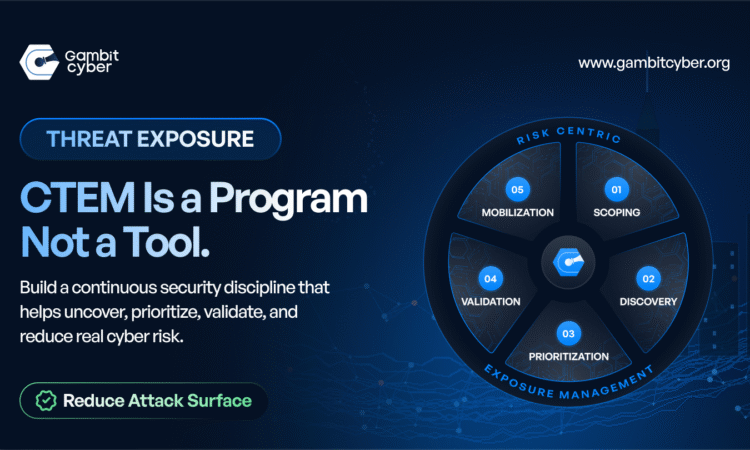
CTEM thrives on repetition and refinement — a living cycle that continuously adapts. Each loop builds clarity and resilience through five repeatable stages:
Define What Matters: Focus on assets that align with business goals — the real "crown jewels."
Discover What Exists: Uncover unknown assets, shadow IT, and unmonitored exposures.
Prioritize What's Critical: Shift from CVSS severity to exploitability and business relevance.
Validate What's Real: Test whether exposures can actually be exploited.
Remediate What Reduces Risk: Fix what measurably lowers exposure, not just what closes a ticket.
Then, repeat. Risk never stops changing, neither can our response.
The Mindset Shift
CTEM is not a project with an end date — it's an ongoing discipline. The moment you complete remediation, discovery starts again. Organizations that embrace this continuous feedback model evolve from reactive vulnerability patching to proactive exposure management and from firefighting to foresight.
Up Next: In Part 3, we'll explore the architectural considerations and foundational design principles for operationalizing a holistic CTEM framework that scales with modern enterprise environments.
(End of Part 2)





 Book a Demo