I have been thinking about writing this piece for a long time, and this blog is the outcome of discussions with numerous CISOs and SOC leaders over the past 6-9 months. I can still picture that tense room of one of the CISOs, as I sat across from the team. Vulnerability scans ticking green, patch cycles clockwork precise, metrics dashboards pulsing with reassuring data. On paper, they were paragons of diligence, guardians holding the line.
And yet, when I asked them a simple question
“What are the top risks that could actually impact their business today?”
There was a quest for finding a relevant response. Instead of an answer, I was shown dashboards with multiple graphs and numbers, which may be meaningful to the SOC analysts working on the siloed system each day. We come across thousands of vulnerabilities each day with high-severity alerts, but there is no clarity on the reduction of risk from an overall exposure perspective.
That’s when I responded and repeated in almost every organization since then:
“You’re not struggling with security gaps. You’re struggling with understanding and managing exposure.”
What they were looking at wasn’t risk; it was an unfiltered activity bludgeoned with technical information from multiple systems in an unstructured manner, which needs an additional army of analysts to decipher and conclude the simplest metrics like:
- What is my exposure?
- How is my organization doing?
- Am I covered for specific theatre-based threats? If not, what is required?
We all know this: the cybersecurity landscape has shifted. We no longer fight "VULNERABILITIES"; we need to fight “EXPOSURE” that determines real risk. While traditional Vulnerability Management (VM) focuses on patching CVE’s, the modern enterprise is plagued by misconfigured cloud buckets, identity "ghost" privileges, shadow IT & most recently uncontrolled AI integrations in business workflows.
By the way, if your security strategy feels like a disjointed collection of dashboards, you aren't alone but be sure you are not managing risk; instead, you are only running on a highway, without any destination. This disconnect highlights a deeper issue - organizations are overwhelmed with data generated by so many siloed tools and processes, but lack contextual uniformity and clarity.
Now, this is the most interesting part: identifying vulnerabilities is a space that is well addressed and catered to, but understanding how vulnerabilities and other exposures connect in a unified manner to form attack paths and impacts within any organization is what matters for a structured program to give successful results. Therefore, this shift in mindset from only vulnerability focus to exposure and risk management is what enables organizations to move from reactive security to proactive & preemptive exposure management.
Structural Problem: The "Activity Trap" of Disjointed Tools
Instead of asking: How many vulnerabilities do we have?
Let's move towards contextualized probing by asking:
- Which vulnerabilities are actually reachable to your assets?
- Which ones can be chained together? Do you have that visibility?
- Which paths lead to critical assets in your organization?
Security teams operate in silos, each optimizing their own function without a unified way of managing the risk across controls. Vulnerability teams focus on severity scores, Cloud teams rely on misconfiguration findings, and identity teams look for access-related exposures - yet none of these are analyzed together in a comprehensive real-world context. This fragmentation creates blind spots due to a lack of unified contextual metadata mapping and tracking. However, attackers operate holistically, chaining weaknesses together, exploiting gaps, and bypassing the control weaknesses and blind spots.
This is why, without a connected view, most organizations remain exposed despite multiple security tools or resource capabilities. It is not a Human or tool-related problem; it is the approach!
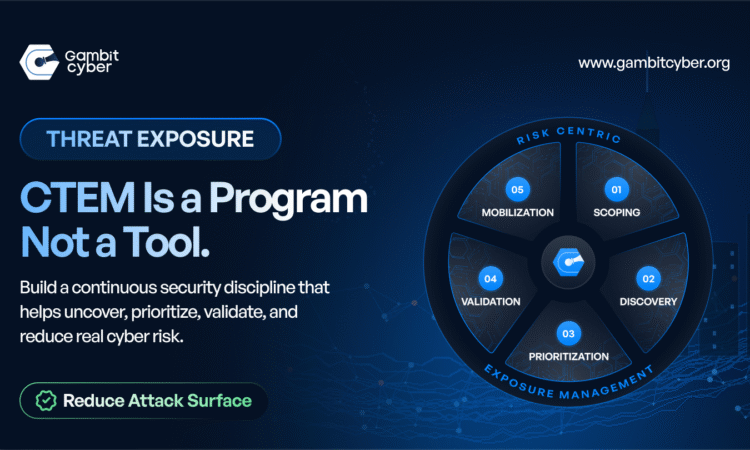
If a CTEM (Continuous Threat Exposure Management) program is operationalized, it would help unify these silos into a single, repeatable cycle addressing the entire exposure in a single, structured manner to get it addressed via realistic exposure prioritization and calculation of true and real risk scoring based on evidence and context.
I am sure most of the fraternity would agree by now that “a vulnerability alone is not a risk”.
Risk emerges when weaknesses connect, and by shifting focus from isolated findings to exposure pathways, validation, and contextualization of such exposures. That is how organizations will gain clarity and the true state of their risk posture, and CISOs/CROs will be able to determine risk and exposure that truly matters.
This approach transforms security from a volume-driven to an intelligence-driven framework, allowing teams to prioritize what is exploitable rather than what is merely presented as a possible vulnerability, which may or may not have an impact.
In the next part, I will emphasize formulating the CTEM program and how we can transform towards a structured CTEM Program approach. Stay Tuned!!!
About the Author:
Ishtiyaq Shah is the Principal Solutions Architect at Gambit Cyber. He is a highly respected technology and cybersecurity leader with over two decades of experience across the global security ecosystem.
He has led the design and operationalization of large-scale Security Operations Centres (SOCs) and is known for building security monitoring and observability environments aligned with global frameworks. In recent years, Ishtiyaq has been at the forefront of applying AI and automation to security operations, helping organizations move from reactive defence to proactive, predictive security models.
Disclaimer:
The information provided on this blog is intended for general information purpose only and does not constitute legal, financial, medial, or other advice. By using the blog, you hold the author and Gambit Cyber B.V. harmless from all claims, damages, or expenses arising from the use.





 Book a Demo