Unified Vulnerability Operations Center
every scanner, one prioritized queue, one SLA
Pull every scanner's findings into one queue, ranked by what is most likely to be used against you.
Most organisations run several scanners, each with its own console, severity scale and backlog. The same CVE appears three times, thousands of findings are rated High, and nobody can say which are on time, which are breached, or whether a closed ticket actually fixed anything.
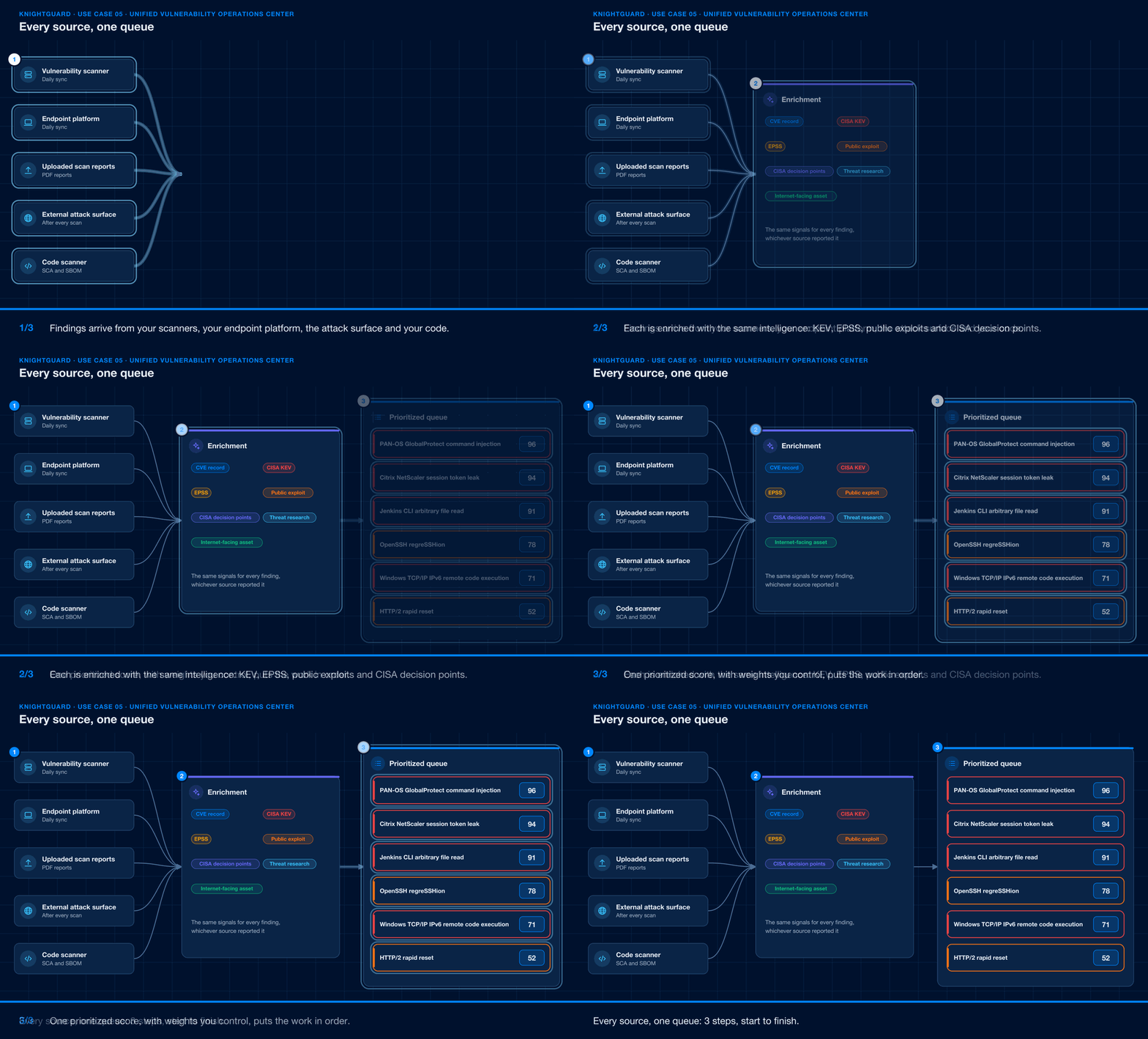
The Operations Center ingests findings from your vulnerability scanners, your endpoint platform, your external attack surface and your own code. It enriches every one with the same threat intelligence, scores them on one scale with weights you control, gives each a due date from your SLA policy, and holds tickets open until the fix is validated.
Where it works in CTEM
Contribution by stage across the continuous exposure management lifecycle.
Share of this use case's platform capability at each CTEM stage. The five shares sum to 100%. & the cycle repeats continuously
SCOPING
5%Set policy and value. An SLA per severity, asset classification by environment and confidentiality, and the choice of whether unconfirmed external matches belong in the queue.
DISCOVERY
20%Ingest every source. Tenable and SentinelOne syncs, uploaded Tenable reports, confirmed external findings after every scan, and code weaknesses and vulnerable dependencies from the code scanner.
PRIORITIZATION
35%One score, your weights. Each finding scored on CVSS, EPSS, CISA KEV, public exploits, CISA decision points, threat research and internet exposure, with weights your administrators tune.
VALIDATION
10%Confirm before closing. A finding whose ticket is done waits in Awaiting Validation until the fix is confirmed on the asset, by hand or with AI-assisted validation, then is marked fixed or reopened.
MOBILIZATION
30%SLA, tickets, closure. Due dates and nightly breach checks, Jira and ServiceNow tickets with remediation guidance attached, ticket status read back every six hours, and an exposure report.
How it works
Each step follows the CTEM stage it belongs to.
Set policy
SLA days per severity, asset classification
Ingest
Scanners, endpoints, attack surface, code
Enrich and score
KEV, EPSS, exploits, CISA decision points, your weights
Due date and ticket
SLA due date, Jira or ServiceNow, remediation guidance
Validate the fix
Awaiting Validation until the fix is confirmed
Close and report
Fixed or reopened; SLA compliance and exposure report
Key capabilities
One queue for every source
Tenable and SentinelOne sync daily; Tenable PDF reports can be uploaded; confirmed external attack surface findings arrive after every scan; the code scanner adds code weaknesses (SCA) and vulnerable dependencies (SBOM).
Explainable prioritization
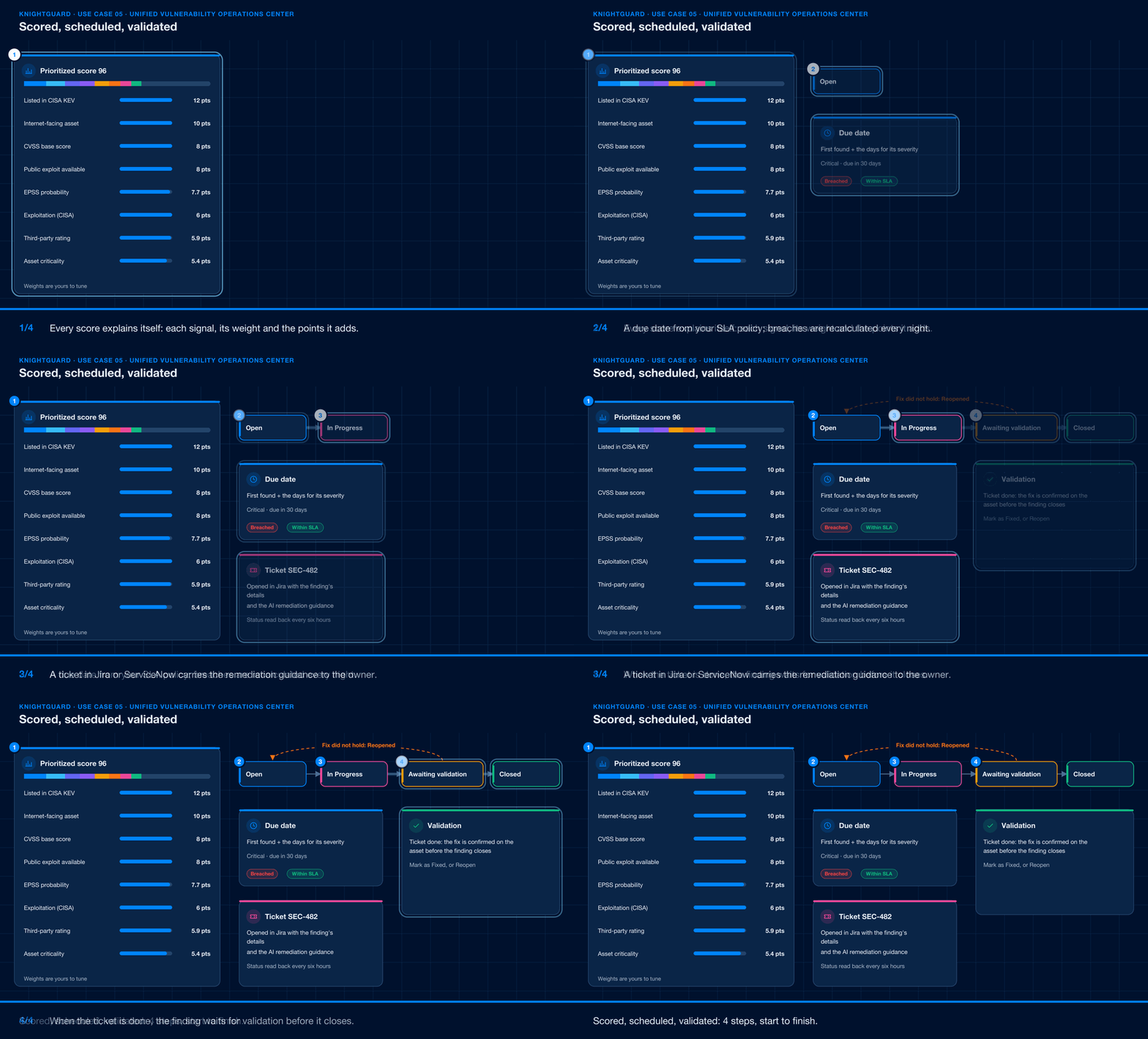
Every score opens to show each criterion, its signal, weight and points. Administrators change the weights and re-score every finding; findings confirmed reachable from the internet get an uplift.
SLA you can report on
Due dates from your policy, breaches recalculated nightly, SLA compliance by severity and a compliance trend on the dashboard, and Breached as its own view.
Investigation in one drawer
Impact, affected products, known exploits and CISA decision points, how the CVE is typically exploited, CVSS vectors and references, with AI remediation guidance attached to the ticket.
Decisions that stick
False positives need a reason and stay put when scans report them again on the same assets; a new asset reopens them. Sources never override a stage or due date you set.
One asset, one record
Cloud accounts, Tenable and SentinelOne feed one inventory; Merge Review groups records that look like the same asset by the strength of the evidence.
Every source, one queue
Every source enriched with the same intelligence and ordered by one prioritized score.
Scored, scheduled, validated
An explainable score, an SLA due date, a ticket, and validation before the finding closes.
Download the Unified Vulnerability Operations Center Datasheet
Unlock the PDF linked to this use case after a short contact form. The file is saved to your downloads folder immediately after submit.
Ready to level up your cyber defence?
Supports modern enterprises with agentic AI discovery, real-time threat validation, and autonomous exposure prioritization.