Unified Attack Path Identification and Validation
across external and internal assets, to the crown jewels
Follow the attack from the internet to your most valuable data, and prove which paths are really open.
External scanners stop at the perimeter and cloud tools stop at the account boundary, so the route an attacker would actually take, from an exposed host into the cloud account behind it and on to customer data, falls between them. Without that route, a misconfiguration one hop from the crown jewels looks the same as one on a test machine.
KnightGuard joins its outside-in attack surface scan to what your connected cloud accounts reveal: which assets can reach, assume or access which others. It draws the chains from internet entry points through hosts, cloud accounts and resources to the crown jewels, explains why each path exists, and gives every step the checks needed to validate it.
Where it works in CTEM
Contribution by stage across the continuous exposure management lifecycle.
Share of this use case's platform capability at each CTEM stage. The five shares sum to 100%. & the cycle repeats continuously
SCOPING
10%Mark the crown jewels. Your domain and cloud accounts set the estate; data stores that matter most are marked as crown jewels, and assets can be classified by environment and confidentiality.
DISCOVERY
20%Map the connected estate. Internet-facing hosts linked through IP addresses, origins and DNS to the cloud hosts, accounts and resources behind them. Reverse DNS reveals cloud machines missing from inventory.
PRIORITIZATION
25%Rank paths, not findings. Each path carries a risk and a number of steps from entry point to crown jewel, and each host's attack probability shows which entry points an attacker is most likely to use.
VALIDATION
35%Prove each step. Every finding on a path carries validation steps and evidence; where automated red teaming is enabled, CVEs show whether a check confirmed them, and an Exposure Validation Report is issued.
MOBILIZATION
10%Break the path early. Each path has a summary and remediation, and Send Details To The Team raises a ticket. Fix the step that cuts the most paths first.
How it works
Each step follows the CTEM stage it belongs to.
Crown jewels
The data stores and systems that matter most
External entry points
Hosts reachable from the internet, scored
Cloud relationships
What can reach, assume or access what
Chain the path
Internet to host to account to crown jewel
Validate each step
Checks, evidence and validation results
Cut the path
Remediate the step that breaks most paths
Key capabilities
Connected Estate Graph
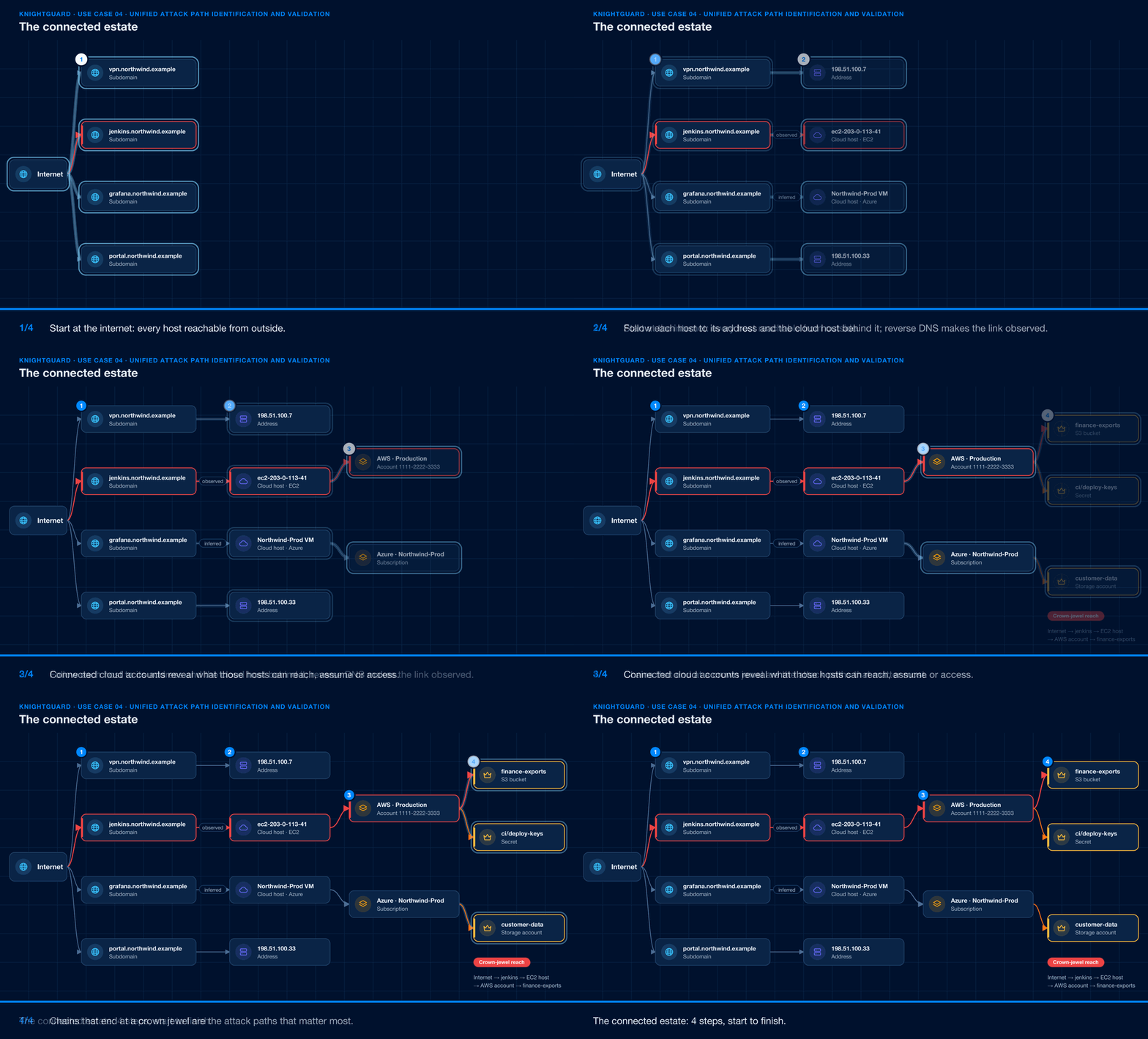
Internet, subdomains, IP addresses, cloud hosts, cloud accounts and crown jewels on one canvas. A link is observed when reverse DNS names the cloud machine, and inferred when it rests on the network owner alone.
Attack-path narratives
Each chain told as a sequence of steps, with the resource type, cloud and region at every hop, so an application or cloud owner sees exactly how their system is reached.
Paths through the cloud estate
Entry points with High or Critical findings, traced Through, To or From any asset, with the route from entry point to crown jewel and why the path exists.
Validation built into the path
Verify-it-yourself commands for exposed services, web- and host-based validation steps for serious CVEs, and leaked-credential checks for login pages, grounded in vendor advisories.
Automated validation, where enabled
With automated red teaming enabled for an authorised scope, CVE findings show Confirmed, Checked: not detected, or Validation failed, and the Exposure Validation Report documents each engagement.
Remediation that breaks paths
A path card's Remediate opens its summary and fix, and Send Details To The Team raises a ticket for the path, so the fix that cuts several paths at once can be done first.
The connected estate
Internet-facing hosts followed through addresses, cloud hosts and accounts to the crown jewels.
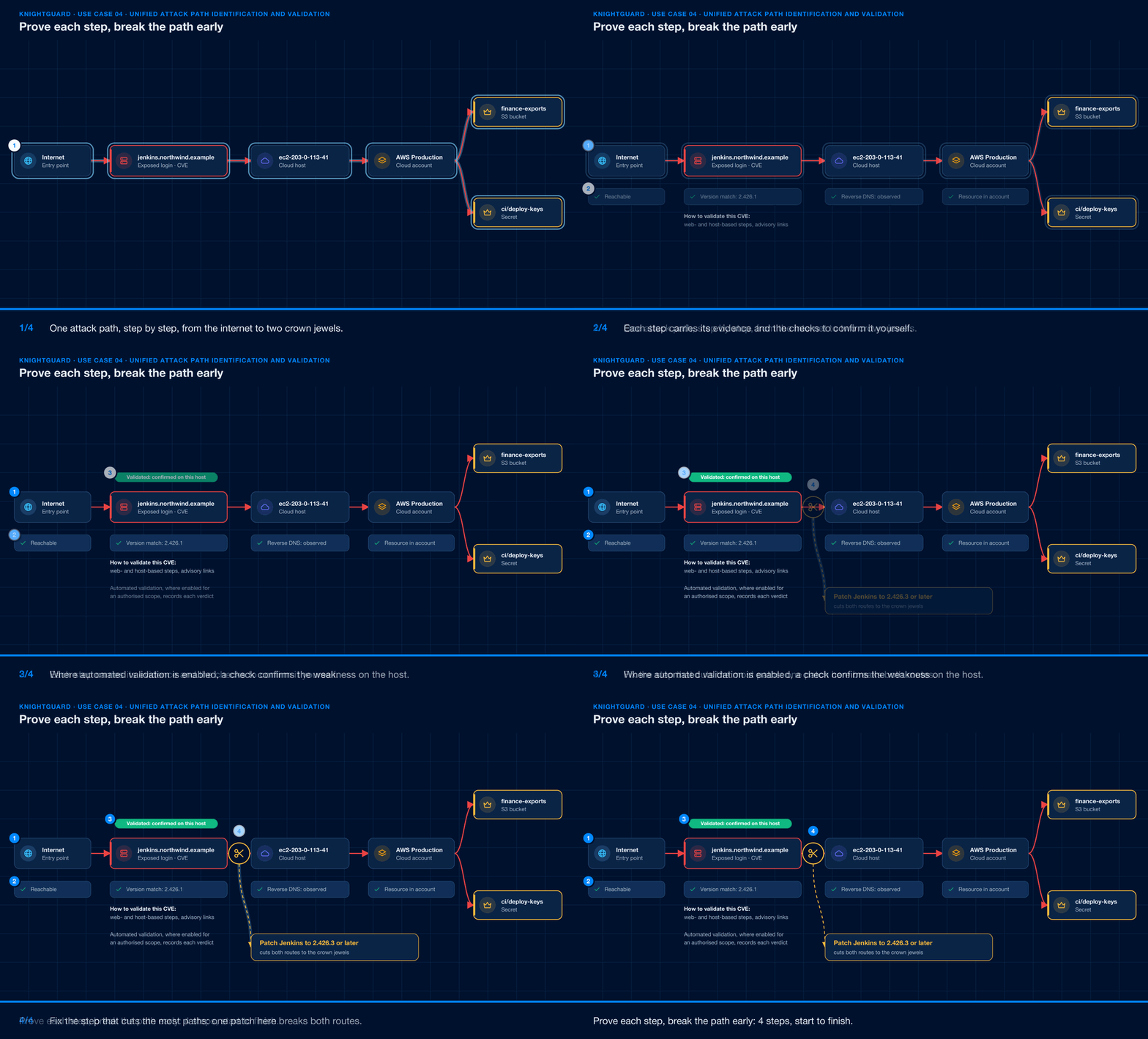
Prove each step, break the path early
Each step of a path carries its evidence and checks; one fix can break several routes at once.
Ready to level up your cyber defence?
Supports modern enterprises with agentic AI discovery, real-time threat validation, and autonomous exposure prioritization.