Risk Quantification
cyber risk in money, tied to your measured exposure
Put a money figure on your cyber risk, linked to the exposures you actually have, and see which control reduces it most.
Boards and insurers ask what a ransomware attack or a business email compromise would cost, and security teams answer with heat maps. Budget requests and insurance limits end up resting on judgement, with no link to the exposures the security team can see.
KnightGuard quantifies loss scenarios with a FAIR-inspired model: how often a threat event is expected, scaled for your region and industry, and what each incident would cost, split into primary and secondary loss. Exposure measured on your own estate, such as leaked credentials, internet-exposed and misconfigured assets and known-exploited vulnerabilities, raises or lowers that frequency. The result is an annual loss to budget for, a 1-in-20-year loss to insure for, and the control that would reduce the risk most.
Where it works in CTEM
Contribution by stage across the continuous exposure management lifecycle.
Share of this use case's platform capability at each CTEM stage. The five shares sum to 100%. & the cycle repeats continuously
SCOPING
20%Choose the loss scenarios. Loss scenarios such as ransomware, business email compromise, data breach, DDoS, insider and supply chain, linked to a risk profile; the gap assessment calibrates its scenarios to your market.
DISCOVERY
20%Measure your exposure. Exposure measured on your estate: leaked credentials, internet-exposed and misconfigured assets, and known-exploited, critical and high vulnerabilities, weighted per scenario.
PRIORITIZATION
40%Quantify and rank. Annual loss expectancy, a typical year, 1-in-20 and 1-in-100 years and the likelihood of each scenario, with the next best control to reduce it.
VALIDATION
5%Check the defences. Each scenario's ATT&CK techniques are shown with their detection coverage, so you can see whether the attack it models would be detected.
MOBILIZATION
15%Treat and report. Risk treatment shows how the controls and products you apply cut a scenario's worst case and likelihood, with their cost; the Gap Analysis Report takes the figures to the board.
How it works
Each step follows the CTEM stage it belongs to.
Pick scenarios
Ransomware, BEC, data breach, DDoS, insider, supply chain
Measure exposure
Leaked credentials, exposed assets, exploited CVEs
Frequency
Threat events a year, for your region, industry and exposure
Loss
Primary and secondary loss per incident, in your currency
Decide
Budget for the expected year, insure for the 1-in-20
Key capabilities
Risk in money, not colours
Annual Loss Expectancy (Budget For This), a typical year, better and worse years, the 1-in-20 year (Insure For This) and the 1-in-100 year, from 10,000 simulated years.
Calibrated to your market
The gap assessment quantifies ransomware and business email compromise with frequency and loss factors for your region and industry, in your region's currency, each loss split into primary and secondary.
Exposure from your own estate
Leaked credentials, internet-exposed and misconfigured assets and known-exploited vulnerabilities from the platform's own scans raise or lower how often each loss is expected.
Likelihood with your controls
The chance of at least one event a year, banded high, medium or low, reduced by the controls you have in place and plotted against the loss it would cause.
Next best control
The gap assessment re-quantifies ransomware and business email compromise with the technologies you already run, and names the control category that would reduce what remains the most.
Risk treatment
Apply controls and products to a scenario to see its reduced worst case and likelihood next to what the controls cost.
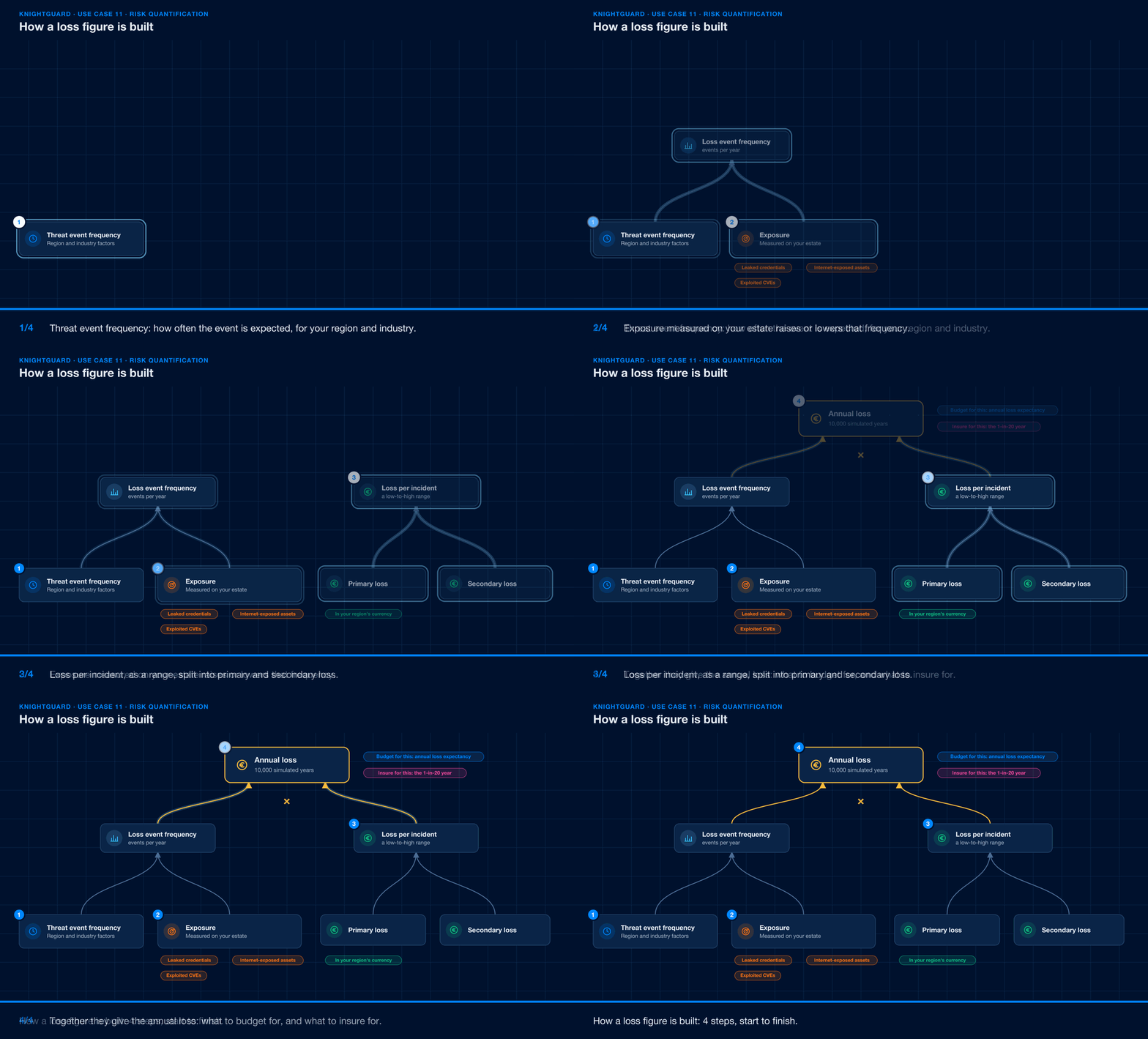
How a loss figure is built
Frequency for your market and exposure, times the loss per incident, gives the annual loss.
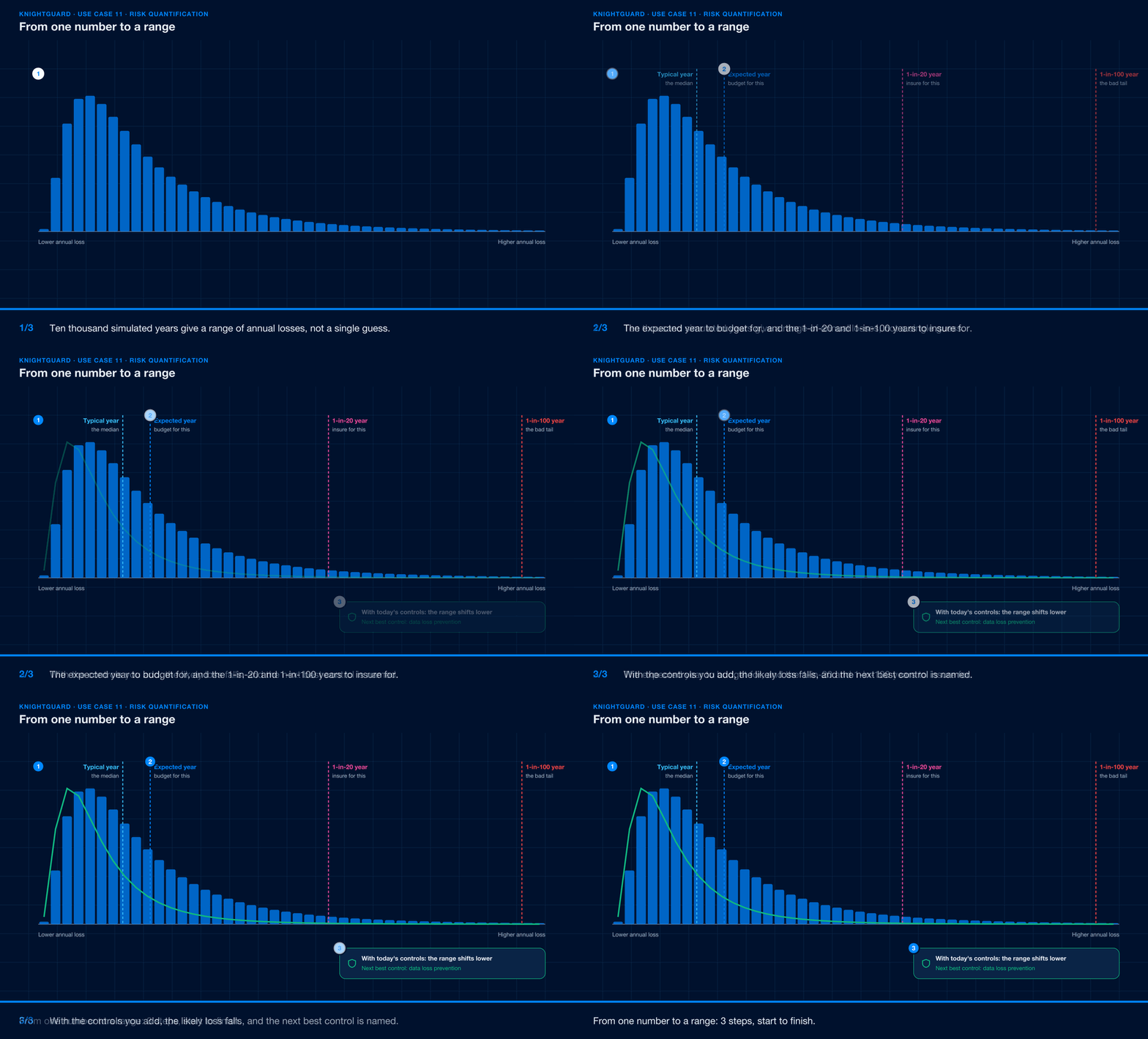
From one number to a range
Simulated years give a range: the year to budget for, the years to insure for, and the effect of controls.
Download the Risk Quantification Datasheet
Unlock the PDF linked to this use case after a short contact form. The file is saved to your downloads folder immediately after submit.
Ready to level up your cyber defence?
Supports modern enterprises with agentic AI discovery, real-time threat validation, and autonomous exposure prioritization.